

Digital marketing is no longer simply about maintaining a website or posting regularly on social media. Businesses today use multiple digital channels to attract potential customers, communicate with their audiences, generate leads, and support sales. With so many platforms and marketing activities available, knowing what to do, where to do it, and why it should be done becomes increasingly important.
This is where a well-planned digital marketing strategy becomes valuable.
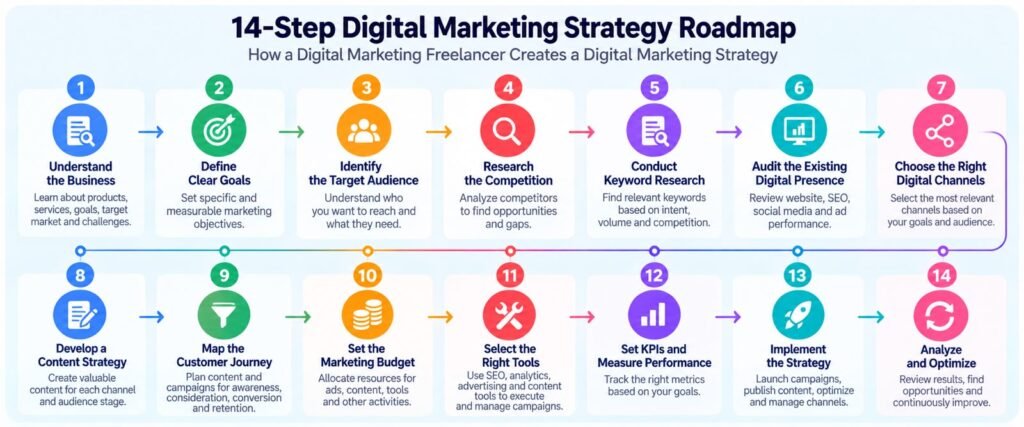
A digital marketing freelancer can help businesses create a structured approach to their online marketing by combining research, planning, content, SEO, social media, paid advertising, website optimisation, and performance measurement. Rather than randomly using different platforms, a freelancer can identify the activities that are most relevant to a particular business and connect them to a clear digital marketing strategy. Also, it helps ensure that every marketing activity has a defined purpose and contributes to the overall business goal.
A digital marketing freelancer can help businesses build a stronger online presence through SEO, social media, paid advertising, content marketing, and other digital marketing activities.
However, an effective strategy is not the same for every business. A startup launching its first product will have different priorities from an established e-commerce company. Similarly, a local service business may require a different approach from a national B2B company.
A good digital marketing strategy therefore starts with understanding the business, its customers, competitors, resources, and objectives.
This article explains how a digital marketing freelancer creates a digital marketing strategy, from the initial business analysis to research, channel selection, content planning, implementation, and performance measurement.
What is a Digital Marketing Strategy?
A digital marketing strategy is a structured plan that explains how a business will use digital channels to achieve specific marketing and business objectives.
These channels can include:
- Search engines
- Social media
- Websites
- Blogs
- Email marketing
- Google Ads
- Meta Ads
- Video platforms
- Content marketing
- Online communities
A strategy determines which channels should be used, what type of content should be created, who the business should target, what message should be communicated, and which metrics should be monitored.
For example, an e-commerce brand may use SEO to attract organic traffic, Instagram to build awareness, Google Ads to capture purchase intent, and email marketing to communicate with existing customers.
A B2B company may instead focus on SEO, LinkedIn, educational content, webinars, email marketing, and lead-generation landing pages.
The important point is that digital marketing strategy should be built around the business and its audience, rather than simply following the latest marketing trend.
“If you want to understand the broader role, responsibilities, services, and working process of a freelancer, read my complete guide to digital marketing freelancing.”
Why does a Digital Marketing Freelancer need a strategy?
A well-defined digital marketing strategy gives the freelancer a framework for deciding which activities should be prioritised.
Without a strategy, digital marketing activities can easily become disconnected.
A business may publish Instagram posts, write blogs, run advertisements, and send emails without knowing whether these activities are contributing to its overall goals.
A strategy provides direction.
It helps answer questions such as:
- Who are we trying to reach?
- What does the business want to achieve?
- What problems does the audience have?
- Which channels should we use?
- What type of content should we create?
- How much should we invest?
- Which metrics should we monitor?
- What should be improved?
For example, if a business wants to increase organic website traffic, the freelancer may prioritise SEO, keyword research, technical optimisation, and content creation.
If the objective is to generate leads quickly, paid advertising, landing pages, conversion tracking, and lead-generation campaigns may receive greater attention.
Therefore, strategy provides the framework that determines where marketing effort should be invested and how different activities work together.
A clear digital marketing strategy helps ensure that each marketing activity contributes to a larger business objective.
Step 1: Understand the Business
The first stage of developing a digital marketing strategy is understanding the business and its current marketing position.
Before recommending a marketing channel, a freelancer needs to understand what the company sells, who it serves, how it operates, and what it wants to accomplish.
This initial discovery process may include questions about:
- Products or services
- Target market
- Business model
- Location
- Existing customers
- Competitors
- Current website
- Social media presence
- Previous marketing campaigns
- Marketing budget
- Business objectives
The freelancer may also ask about the company’s biggest marketing challenges.
For example:
- Is the business struggling to generate leads?
- Does the website receive very little organic traffic?
- Is social media engagement low?
- Are paid campaigns generating clicks but few conversions?
- Is the business launching a new product?
- Does the brand need greater online visibility?
Understanding these challenges gives the freelancer a starting point for developing the strategy.
Defining Clear Marketing Objectives
These objectives provide a foundation for building a digital marketing strategy that can be measured and improved over time.
Once the business is understood, the next step is to identify clear objectives.
A goal such as “grow online” is too broad to guide a marketing strategy effectively.
Instead, a business could define objectives such as:
- Increase organic website traffic
- Generate qualified leads
- Increase online sales
- Improve brand awareness
- Increase social media engagement
- Improve search visibility
- Increase enquiries
- Launch a new product successfully
Clear objectives make it easier to select the right channels and establish appropriate KPIs.
For example, if the objective is to increase organic traffic, SEO-related metrics become important.
If the objective is to generate leads, the strategy may focus on landing pages, advertising, conversion tracking, and lead quality.
These objectives give the digital marketing strategy a clear direction and make later performance measurement easier.
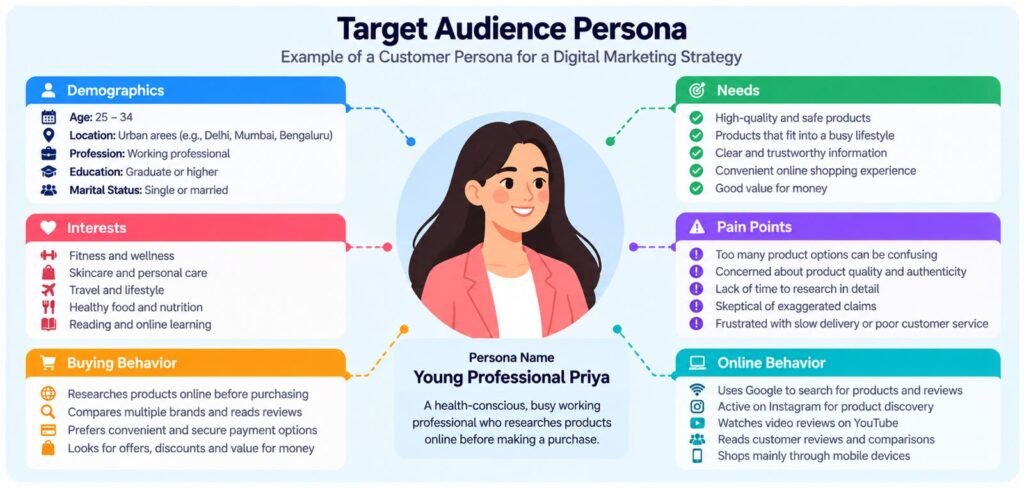
Step 2: Identify the Target Audience
Understanding customer needs allows a digital marketing strategy to deliver more relevant messages and content.
The next stage is understanding the people the business wants to reach.
A digital marketing freelancer may create an audience profile using information such as:
- Age
- Location
- Profession
- Interests
- Buying behaviour
- Needs
- Pain points
- Online behaviour
- Purchasing motivations
However, audience research should go beyond demographics.
Understanding why people make decisions can help the freelancer create more relevant marketing messages.
For example, instead of defining an audience as:
Women aged 20–35 in India.
A more useful audience profile could be:
Working women looking for affordable skincare products who use Google and Instagram to research products, compare alternatives, and read reviews before purchasing.
Audience research is therefore an essential part of building a digital marketing strategy that speaks to the right people.
This information can influence the:
- Keywords selected
- Content topics
- Advertising messages
- Social media platforms
- Website copy
- Calls to action
The better the freelancer understands the audience, the easier it becomes to create relevant marketing activities.
Step 3: Research the Competition
Competitor research can help strengthen a digital marketing strategy by identifying opportunities that may otherwise be overlooked.
The purpose is not to copy competitors. Instead, competitor research helps identify patterns, opportunities, gaps, and potential areas of differentiation.
A freelancer may examine:
- Competitor websites
- Search rankings
- Keywords
- Blog content
- Social media activity
- Content formats
- Advertising messages
- Offers
- Calls to action
- Audience engagement
For SEO, competitor research can reveal topics and keywords that competing websites are targeting.
For social media, it can help identify content formats that audiences appear to interact with.
For paid advertising, competitor research can provide insight into messaging and positioning.
The freelancer can then use these observations as part of the strategy while maintaining the client’s own brand identity.
Step 4: Conduct Keyword Research
Keyword research is particularly important when SEO and content marketing are part of the digital marketing strategy.
Keywords are the terms and phrases people use when searching for information, products, services, or solutions.
A freelancer may evaluate keywords based on:
- Relevance
- Search intent
- Search volume
- Competition
- Business value
- Topic relevance
For example, a digital marketing freelancer may research terms such as:
- Digital marketing freelancer
- SEO freelancer
- Digital marketing services
- Freelance digital marketer
- Digital marketing consultant
- Social media marketing freelancer
But keyword selection should not be based solely on search volume.
These insights can help shape the SEO and content components of the digital marketing strategy.
Search intent is equally important.
Consider the difference between:
“What is SEO?”
and:
“SEO freelancer for small business”
The first search is primarily informational. The second may indicate that someone is researching a potential service.
Understanding intent helps a freelancer decide whether a keyword should be targeted through an informational blog, service page, landing page, or another type of content.
Step 5: Audit the Existing Digital Presence
The results of this audit can help determine which areas of the digital marketing strategy need the most attention.
Before creating a new strategy, a freelancer should understand what the business is already doing online.
This is often done through a digital marketing audit.
Website Audit
The freelancer may examine:
- Website structure
- Navigation
- Mobile experience
- Page speed
- Website content
- Calls to action
- Landing pages
- User experience
The objective is to identify areas that may be preventing visitors from finding information or taking action.
SEO Audit
An SEO audit can examine:
- Existing keyword rankings
- On-page SEO
- Technical SEO
- Meta titles
- Meta descriptions
- Internal linking
- Indexed pages
- Content gaps
This helps establish the current search visibility of the website.
Social Media Audit
A social media audit may review:
- Profile optimization
- Content quality
- Posting consistency
- Engagement
- Content formats
- Audience response
Paid Advertising Audit
If the business is already running paid campaigns, the freelancer may evaluate:
- Campaign structure
- Targeting
- Ad creatives
- Budget allocation
- Click-through rates
- Conversion tracking
- Cost per result
An audit gives the freelancer a baseline from which the new strategy can be developed.
The findings from these audits can then be used to refine the digital marketing strategy before implementation begins.
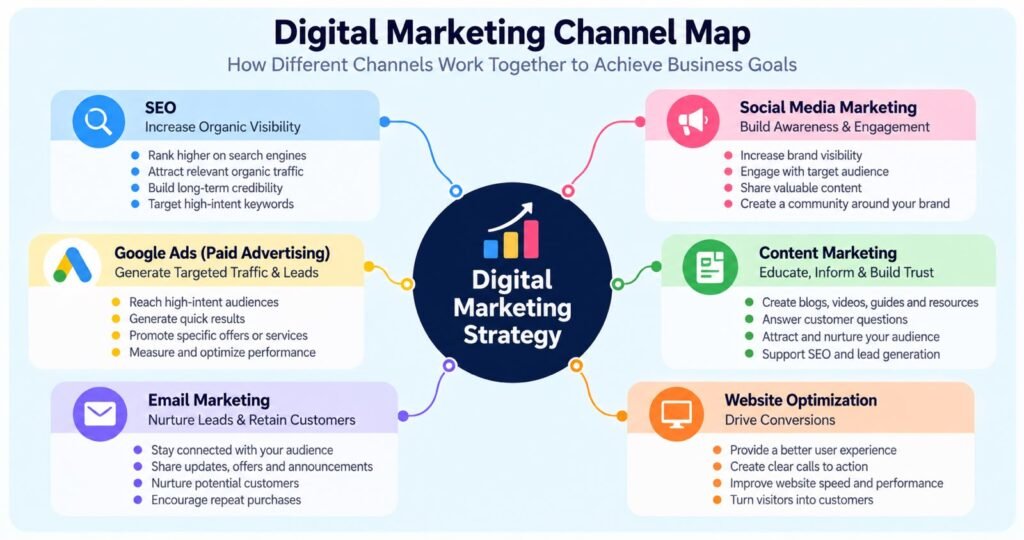
Step 6: Choose the Right Digital Marketing Channels
The right combination of channels can make a digital marketing strategy more effective and consistent.
One of the most important decisions in strategy development is choosing the appropriate digital marketing channels.
A business does not necessarily need to use every available platform.
The right channels depend on:
- Target audience
- Business objectives
- Industry
- Budget
- Resources
- Customer journey
- Product or service
- Content capabilities
For example:
| Digital Channel | Common Objective |
|---|---|
| SEO | Increase organic visibility |
| Social Media | Build awareness and engagement |
| Google Ads | Generate targeted traffic and leads |
| Content Marketing | Educate and attract audiences |
| Email Marketing | Nurture leads and customers |
| Website Optimization | Improve user experience and conversions |
Choosing the right channels is one of the most important decisions when developing a digital marketing strategy.
The goal is not to be present everywhere.
The goal is to identify the channels where the business can realistically reach its audience and achieve its objectives.
Step 7: Develop a Content Strategy
A well-planned content approach makes the digital marketing strategy more consistent across different platforms.
Content is a major component of many digital marketing strategies.
A freelancer may develop content for:
- Blogs
- Social media posts
- Reels
- Videos
- Guides
- Infographics
- Case studies
- Email newsletters
- Landing pages
The content should support the overall marketing objective.
For example, blog content can help attract organic traffic through search engines.
Social media content can support awareness and engagement.
Educational content can answer customer questions and build trust.
Landing page content can guide visitors toward a conversion.
Create Content Pillars
Content pillars are broad themes around which content can be organized.
For a digital marketing freelancer, content pillars could include:
- SEO
- Social media marketing
- Content marketing
- Paid advertising
- Digital marketing strategy
Each pillar can then be divided into smaller topics.
This creates a more organized content plan and makes it easier to maintain consistency.
These content pillars give the digital marketing strategy a consistent structure and make content planning easier.
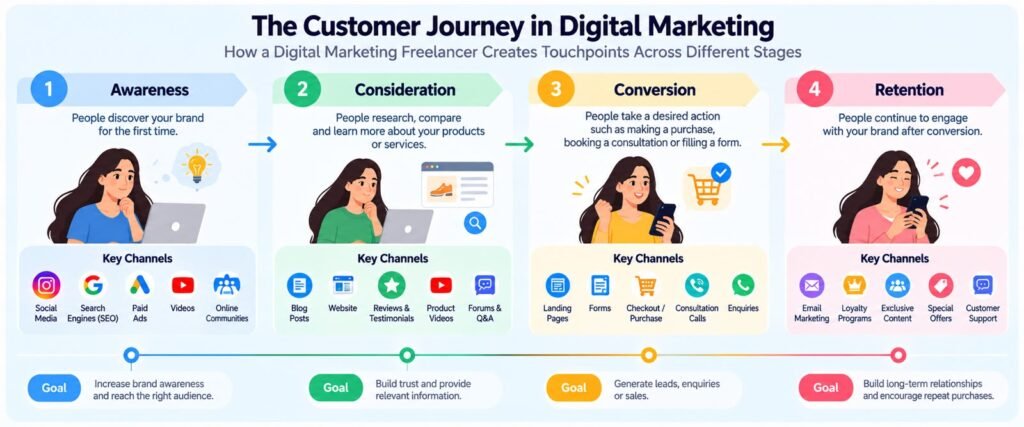
Step 8: Map the Customer Journey
A digital marketing strategy should consider the different stages of the customer journey.
Not every person who discovers a business is ready to make a purchase.
A simple customer journey can be divided into four stages.
1. Awareness
The customer discovers the business.
Potential channels include:
- Social media
- Search engines
- Blogs
- Videos
- Advertising
2. Consideration
The customer begins researching.
They may:
- Visit the website
- Read reviews
- Compare alternatives
- Read blog posts
- Watch videos
- Explore social media
3. Conversion
The customer takes a desired action.
This could be:
- Purchasing a product
- Filling out a form
- Booking a consultation
- Requesting information
- Sending an enquiry
4. Retention
After conversion, the business can continue building the relationship through:
- Email marketing
- Loyalty programs
- Educational content
- Offers
- Customer communication
Understanding these stages allows the freelancer to create marketing activities for different points in the customer journey.
Mapping these stages helps ensure that the digital marketing strategy supports customers throughout their journey.
Step 9: Set the Marketing Budget
Budget is another important part of strategy development.
A realistic budget allows the digital marketing strategy to be implemented consistently without unnecessarily spreading resources across too many activities.
A freelancer needs to understand how much the business can realistically invest in digital marketing.
The budget may be divided between:
- Paid advertising
- SEO
- Content creation
- Website development
- Design
- Software
- Influencer campaigns
- Social media management
A smaller business may need to prioritise a few channels rather than spreading its resources too thinly.
A larger business may have the resources to run several campaigns simultaneously.
The strategy should therefore be realistic and aligned with the available resources.
A simple, focused strategy that can be executed consistently is often more useful than a large plan that cannot be maintained.
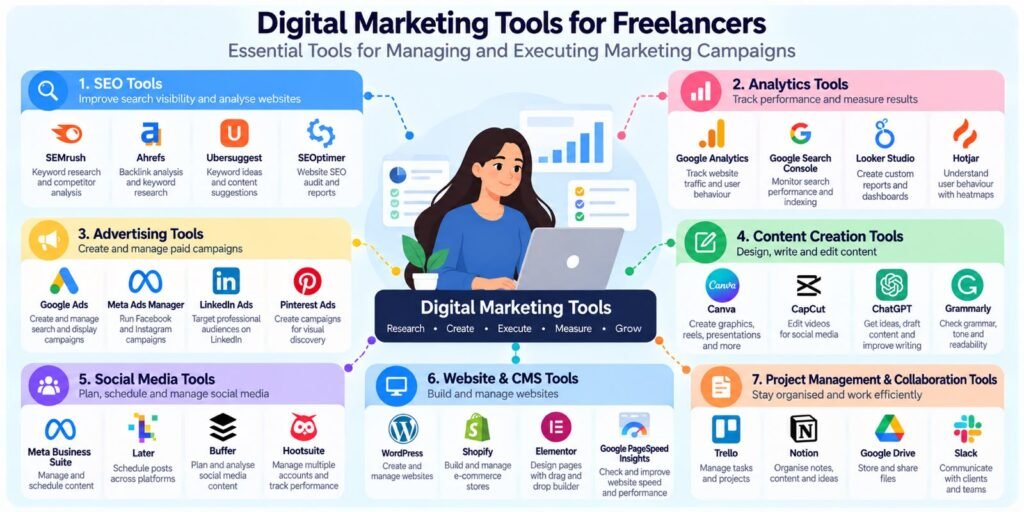
Step 10: Select the Right Digital Marketing Tools
Once the freelancer has identified the marketing activities that need to be performed, the next step is selecting appropriate tools.
Different tools support different parts of the digital marketing process.
For example:
- SEO tools can support keyword research and website analysis.
- Analytics platforms can help measure website performance.
- Advertising platforms can be used to manage paid campaigns.
- Content creation tools can help produce graphics and other creative assets.
- Website platforms can support website management.
- Social media tools can help organize and manage content.
A freelancer does not necessarily need every marketing tool available. The selection should depend on the project’s requirements, budget, workflow, and objectives.
A digital marketing freelancer can use a range of digital marketing tools to conduct research, manage campaigns, create content, and measure performance.
Step 11: Create a Content Calendar
Once the strategy and content themes have been established, the freelancer can create a content calendar.
A content calendar helps determine:
- What will be published
- When it will be published
- Which platform will be used
- What the content objective is
- Who is responsible for creating it
- Which campaign it supports
For example:
| Week | Content | Platform | Objective |
|---|---|---|---|
| Week 1 | Educational blog | Website | SEO |
| Week 1 | Short-form video | Awareness | |
| Week 2 | Educational carousel | Engagement | |
| Week 2 | Promotional campaign | Meta Ads | Leads |
| Week 3 | Blog article | Website | Organic traffic |
| Week 4 | Newsletter | Retention |
The exact schedule will vary depending on the business.
The important point is that content should be connected to the strategy rather than created randomly.
Step 12: Set KPIs and Measure Performance
A digital marketing strategy needs measurable indicators.
These are commonly referred to as Key Performance Indicators (KPIs).
The right KPIs depend on the objective.
Measuring the right indicators helps determine whether the digital marketing strategy is producing the expected results.
SEO KPIs
A freelancer may monitor:
- Organic traffic
- Keyword rankings
- Search impressions
- Click-through rate
- Organic conversions
Social Media KPIs
These may include:
- Reach
- Engagement
- Video views
- Profile visits
- Website clicks
Paid Advertising KPIs
These may include:
- Impressions
- Click-through rate
- Cost per click
- Leads
- Cost per lead
- Conversions
- Return on ad spend
The important thing is to connect the KPI to the actual business objective.
For example, if the goal is lead generation, follower growth alone may not provide enough information about campaign performance.
Step 13: Implement the Strategy
Following a structured digital marketing strategy can make implementation more organised and easier to evaluate.
Once the strategy has been planned, the freelancer can begin implementation.
Depending on the project, implementation may include:
- Publishing content
- Optimising website pages
- Launching advertising campaigns
- Managing social media
- Creating landing pages
- Conducting SEO activities
- Sending email campaigns
- Setting up analytics and tracking
Implementation should follow the priorities established during the strategy phase.
For example, if an SEO audit identified important technical issues, those issues may need to be addressed before investing heavily in content creation.
Similarly, if a paid campaign depends on a landing page, the landing page should be properly prepared before sending significant traffic to it.
This demonstrates why strategy and execution need to work together.
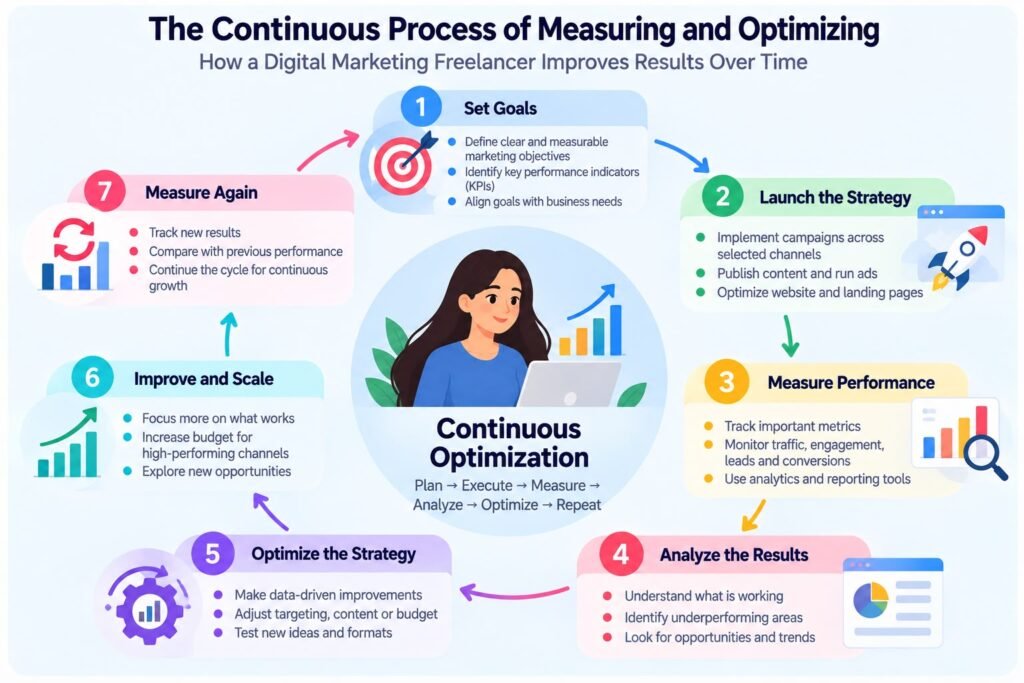
Step 14: Analyze and Optimize the Strategy
Digital marketing does not end when a campaign is launched.
A freelancer should continuously analyze performance and identify areas for improvement.
Questions may include:
- Which channels are generating results?
- Which content receives the most engagement?
- Which keywords are gaining visibility?
- Which advertisements generate conversions?
- Where are visitors leaving the website?
- Which campaigns are using the budget efficiently?
- What should be changed?
For example, a campaign may generate a large number of clicks but very few conversions.
The freelancer could investigate:
- Ad targeting
- Ad messaging
- Landing page experience
- Offer
- Call to action
- Conversion tracking
Similarly, if a blog receives search impressions but very few clicks, the freelancer may review the page title and search-result presentation.
This process of reviewing data and making changes is what allows a strategy to evolve.
How often should a Digital Marketing Strategy be reviewed?
A digital marketing strategy should not be treated as a document that is created once and never changed.
Marketing conditions can change because of:
- New competitors
- Changes in customer behaviour
- New products
- New platforms
- Changes in business objectives
- Campaign performance
- Changes in budget
- Changes in search behaviour
A freelancer may monitor performance regularly and conduct a more detailed strategic review periodically.
The frequency depends on the business and the type of marketing activity.
For example, paid advertising campaigns may require frequent monitoring, while some SEO activities may need a longer period before meaningful changes can be evaluated.
The key is to review performance consistently without changing direction simply because results are not immediate.
Common mistakes when creating a Digital Marketing Strategy
Even a carefully planned strategy can become ineffective when basic mistakes are made.
1. Trying to use every digital channel
A business does not need to be active everywhere.
Using too many channels can divide resources and make consistent execution difficult.
Choose channels based on the audience and objectives.
2. Creating content without a purpose
Publishing content simply to maintain consistency can result in disconnected topics.
Every content piece should have a purpose, whether it is attracting search traffic, educating an audience, increasing awareness, generating leads, or supporting conversions.
3. Ignoring Data
Without reviewing performance data, it is difficult to understand what is working.
Analytics should be used to support marketing decisions.
4. Expecting immediate results from every activity
Different marketing activities work on different timelines.
Some paid campaigns can generate results quickly, while SEO and organic content may require longer-term effort.
Expectations should therefore match the type of strategy being implemented.
5. Focusing only on vanity metrics
Likes, views, and followers can provide useful information, but they may not always represent the business outcome.
Depending on the objective, metrics such as leads, conversions, website traffic, customer acquisition costs, or revenue may be more relevant.
How a Digital Marketing Freelancer Connects Different Channels?
One of the most important parts of strategy development is understanding that digital marketing channels do not have to work independently.
They can support one another.
For example:
SEO → Blog Content → Website → Conversion
A blog article can attract visitors through search engines. Those visitors can then explore the website and potentially become leads or customers.
Another example is:
Social Media → Website → Landing Page → Lead
A social media campaign can generate awareness and traffic, while the landing page provides a focused path toward conversion.
Similarly:
Paid Advertising → Content → Email → Conversion
An advertisement may introduce a customer to the brand, while content and email communication help provide additional information before the customer makes a decision.
This interconnected approach is one of the reasons why having an overall strategy is important.
What Makes a Digital Marketing Strategy Effective?
An effective strategy is not necessarily the one with the most platforms, the highest advertising budget, or the largest amount of content.
Instead, it should have several fundamental characteristics.
Clear Objectives
The business should know what it wants to achieve.
Defined Audience
The strategy should be built around a specific target audience.
Relevant Channels
The selected channels should match the audience and objectives.
Useful Content
Content should provide value and support the customer journey.
Measurable KPIs
Performance should be measurable.
Continuous Optimisation
The strategy should evolve based on performance and changing circumstances.
Realistic Resources
The plan should be achievable within the available budget, time, and skills.
When these elements work together, digital marketing activities become more structured and purposeful.
Regular analysis and optimisation allow a digital marketing strategy to adapt as business goals, customer behaviour, and market conditions change.
Final Thoughts
Creating an effective digital marketing strategy is a process that combines business understanding, audience research, competitor analysis, keyword research, channel selection, content planning, implementation, and performance measurement.
A digital marketing freelancer begins by understanding what the business wants to achieve and who it wants to reach. From there, research helps identify opportunities, challenges, competitors, keywords, and areas for improvement.
The freelancer then chooses appropriate digital marketing channels and develops a plan for content, campaigns, website optimisation, advertising, and other activities.
However, strategy development does not end when implementation begins.
Digital marketing is an ongoing process. Performance needs to be monitored, data needs to be analysed, and campaigns need to be adjusted when necessary.
The strongest strategy is therefore not necessarily the most complicated one. It is the strategy that connects the right audience, message, channel, objective, and measurement process.
For businesses, working with a freelancer can provide access to digital marketing expertise while allowing the strategy to be developed around their specific needs.
And as digital marketing continues to evolve, freelancers also need to stay familiar with the tools and technologies that support research, execution, analytics, content creation, and campaign management.
With regular testing and optimisation, a digital marketing strategy can continue to support long-term business growth.

2 Comments
[…] That process connects directly with the broader strategy discussed in How a Digital Marketing Freelancer Creates a Digital Marketing Strategy? […]
[…] “To understand this process in more detail, read my guide on [How a Digital Marketing Freelancer Creates a Digital Marketing Strategy].” […]